
German Shepherd Training Equipment I Actually Use
The wrong gear makes training harder than it needs to be. A lead that slips through your hands at the exact moment you need it. A collar that sits too loose to communicate anything. A harness that turns a dog who was learning to walk nicely into a dog who has learned to pull.
German Shepherds are strong, fast, and often built differently from the dogs most pet-shop gear is designed for. A 40 kg male with a broad skull needs a different collar to a 26 kg adolescent female — and neither of them needs the clip-on nylon set from the supermarket.
This page lists the equipment I use with client dogs and my own, what each piece is for, and how to pick the right size for your dog. Every item is available from Von Ultimate Dog Shop.
I don't sell equipment and I don't earn commission from these links. This is simply the gear I use, so my clients aren't left guessing.
Why Von Ultimate is my preferred supplier
I've been through enough cheap gear to know what it costs you. A snap hook that fails on a dog in drive isn't a $15 problem — it's a dog loose near a road. When I recommend equipment, I'm recommending something I've already trusted with a dog's safety.
- They supply the working-dog world, not the pet aisle. Von Ultimate is the exclusive Australasian agent and stockist for Dingo Gear, Herm Sprenger, HST, Ray Allen, Cariz and Raddog — the brands used in IGP, police and security work worldwide. Gear built for a protection dog at full commitment is gear that will comfortably outlast a German Shepherd's lifetime of everyday training.
- They've been to the factories. Evan and the team have visited the European workshops that make this equipment, repeatedly, to check the build quality themselves. That's a different business to a drop-shipper who has never held the product.
- The hardware is the difference. Herm Sprenger stainless steel out of Germany. Austrian Cobra buckles rated for genuine load. Bronze clips instead of cheap chrome. Hand-stitched leather and webbing out of Poland and the Czech Republic. These are the details you don't notice until something fails.
- They back the working dog community in Australia. They sponsor police units, security handlers and dog sport clubs around the country, and they've backed Australian competitors onto the world stage at the WUSV championships. They're invested in the same community my training comes from.
- They're local. Based in Doreen, Victoria — same state, fast delivery, and a real person on the phone who knows the product range if you're unsure about sizing.
That's why every piece of equipment on this page comes from one supplier. It isn't a sponsorship. It's just where I buy.
How to choose: sizing your German Shepherd
The single most common mistake I see is a collar bought too big "so he can grow into it." A loose collar can't communicate, and it can be slipped.
Herm Sprenger long link collars — which length?
These are stainless steel chain collars with long links. They sit high on the neck, they don't wear the coat, and they last forever. Pick by your dog's age and build:
| Length | Who it suits |
|---|---|
| 54 cm × 4 mm | Most young German Shepherds — adolescents still filling out, and lighter-framed adult females |
| 59 cm × 4 mm | Most adult German Shepherds. If you're buying one collar for a grown dog, this is usually it |
| 63 cm × 4 mm | Adult males with a large, solid head — the heavier working-line boys who can't get a 59 cm over the skull |
How to check: the collar has to pass over the widest part of the skull, then sit comfortably high behind the ears. If you're between sizes on a dog still growing, size for the head, not the neck.
Girth-based gear (harnesses, Cobra collar) is measured differently — run a soft tape around the chest just behind the front legs for a harness, and around the neck where the collar sits for the Cobra. Measurements are listed with each product below.
Not sure? Bring it up at your session and we'll size it together, or call Von Ultimate — they do this all day.
Starting out: puppy and foundation gear
The first three months set the tone for everything that follows. At this stage you need gear that's light, comfortable, and doesn't create resistance for a puppy still learning that pressure means something.

Dingo Gear Small Puppy Lead and Collar Set
Handmade brown waxed leather from Poland — a 0.8 × 180 cm lead and a 1.6 × 41 cm collar, with chrome-plated fittings and braided lead ends.
Why I recommend it
Note that it's the Small set, not the Extra Small. A German Shepherd puppy outgrows the extra-small 32 cm collar within a few weeks; the 41 cm gives you room through the fastest growth months without ever having to sit loose on the neck.
Waxed leather is soft in the hand from day one and only gets better with use. It's light enough that a puppy barely registers it, which matters enormously in those first sessions where you're teaching that lead pressure is information, not a fight.
The 180 cm lead gives you enough slack to let a puppy explore without teaching them to hit the end of the lead — and the braided ends and chrome fittings are the reason this set survives a puppy who wants to chew it.
Used in: Puppy training, from your first week home.

VUDS Original Ring Clicker
A clicker you wear on your finger rather than hold — ABS body with a stainless steel striker, a comfortable adjustable clasp, one size fits all. Von Ultimate's own design.
Why I recommend it
Marker training is simply being precise about when you tell your dog they were right. The click happens at the exact moment the behaviour does, and that half-second of accuracy is the difference between a dog who understands what you wanted and a dog who is guessing.
The ring format is why I use this one. A handheld clicker occupies a hand you need for the lead, the reward, or the dog. Worn on your finger it's always there, always ready, and it never gets left in the car — which is usually why people quit marker training before it has a chance to work.
The stainless striker gives a cleaner, more consistent sound than the soft plastic box clickers, and a consistent sound matters: the whole system depends on the dog hearing the same thing every time.
Used in: Marker training and foundation communication in every program I run — puppy training, 1-on-1 and board and train.

Dingo Gear Bungee Wool Tug
A 6 × 20 cm wool tug with a shock-absorbing bungee handle, handmade in Poland. Available in green or pink.
Why I recommend it
This is the single most important item on the page for a young German Shepherd. Play is where engagement comes from, and engagement is where everything else comes from. Before obedience, before recall, before anything — your puppy needs to believe that you are the best thing in the environment.
The bungee handle is what makes it puppy-appropriate. A young dog committing hard to a tug against a rigid handle takes that impact through the neck and developing teeth. The bungee absorbs it, so you can build genuine drive and confidence without worrying about the damage. Wool is soft on a mouth that's still changing teeth, and it's the material most young dogs will commit to first.
Used in: Puppy training, engagement work, and as the foundation reward in every program I run.

HST Lambswool Tug with Handle
A 40 × 13 cm tug in genuine lambswool with a one-metre handle. Hand-made in the Czech Republic by HST.
Why I recommend it
This is the tug for the six-to-eighteen-month stage — the step up from the small bungee tug once your puppy has grown into a young dog with a real mouth and real commitment.
The metre-long handle is the whole point. It keeps a young Shepherd's teeth a safe distance from your hands while you animate the tug, and it gives you the reach to drag it along the ground and make the movement genuinely worth chasing. A short tug at this age means you're either getting caught or holding back — neither builds drive.
Lambswool is forgiving on a mouth that's still settling after the adult teeth come through, and it's soft enough that a young dog will commit to a full grip instead of nibbling at the edge. The size is generous, which lets you get two hands on it and play properly.
Used in: Adolescent engagement and play foundations, and as the reward in early obedience with young dogs.

Squishy Face Studio Regular Flirt Pole
A 36-inch pole with a 52-inch bungee cord, soft non-slip grip and wrist strap. The lure changes over without fasteners that could catch a dog's mouth. Made in the USA.
Why I recommend it
A flirt pole teaches a dog how to play — and that's a skill, not an instinct that switches on by itself. Plenty of German Shepherds arrive at my place with big drive and no idea how to channel it into a game with a person. The flirt pole fixes that, because it makes the prey movement obvious and makes you the source of it.
It's also the best confidence-builder I know for a soft or shut-down dog. Chase, catch, win — repeated until the dog believes it can. And on a practical level, it drains a German Shepherd's tank in ten minutes in a suburban backyard, which is worth knowing on a wet Melbourne week.
The bungee cord matters: it prevents whiplash when the dog catches the lure, so you can let them win properly instead of pulling it away.
Used in: Confidence building, play foundations, and arousal-management work with reactive dogs.
Everyday control: collars, leads and harnesses
This is the gear you'll have on your dog every day for the next decade. Buy properly once.

Herm Sprenger 54 cm × 4 mm Black Stainless Steel Long Link
German-made, corrosion resistant, easy to clean. Black stainless finish.
Why I recommend it
The size for most young German Shepherds — adolescents in that gangly stage, and lighter-framed adult females. Stainless steel means it won't rust through a wet Melbourne winter or a beach session, and the long links won't catch and pull coat the way short-link chain does.
The black finish is the same steel, just less conspicuous — worth it if you'd rather your dog didn't look like it's kitted out for a trial when you're walking through Altona Meadows.
Used in: Obedience and everyday handling from adolescence onward.

Herm Sprenger 59 cm × 4 mm Stainless Steel Long Link
German-made, corrosion resistant, easy to clean.
Why I recommend it
The default for most adult German Shepherds. If you own a grown dog of average build and you're buying one collar, this is the one. Herm Sprenger's steel is the reason this brand is standard equipment in police and sport work worldwide — the links are machined and welded to a standard that cheap imitation chain simply isn't, and this collar will outlive the dog wearing it.
Sitting high behind the ears, it gives clear, quiet communication through the lead without the constant hauling that a flat collar invites.
Used in: 1-on-1 training, board and train, and everyday walking for adult dogs.

Herm Sprenger 63 cm × 4 mm Stainless Steel Long Link
German-made, corrosion resistant, easy to clean.
Why I recommend it
For the big, solid-headed males — typically the heavier working lines, where a 59 cm won't clear the skull. If you've tried to fit a 59 cm and it's a struggle to get over the head, this is your size. Same steel, same build, just the length these dogs need.
Don't size up "just in case." A collar that's too long sits loose, slides down the neck, and stops being useful.
Used in: Obedience and everyday handling for larger adult males.
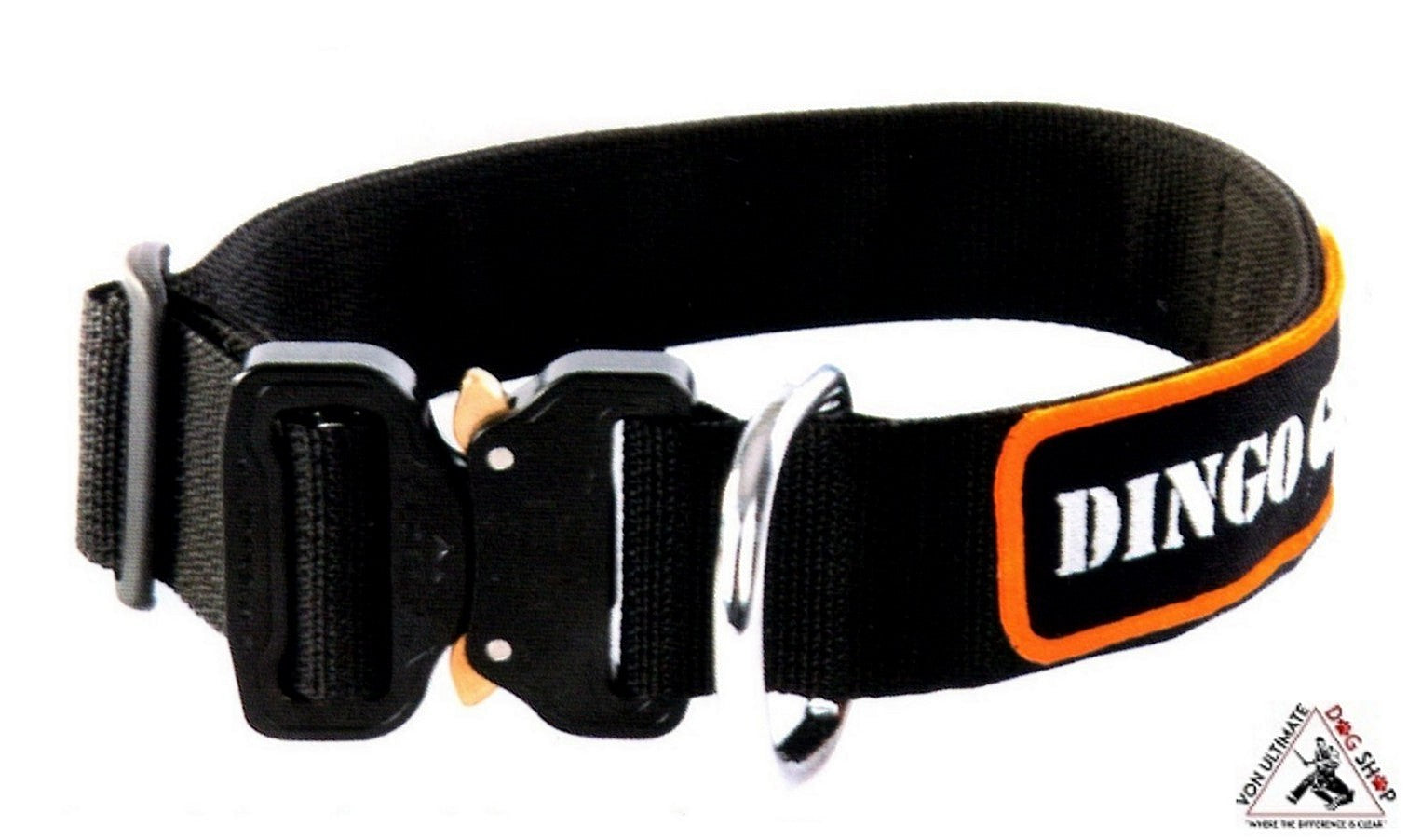
Dingo Gear Cobra Collar (Without Handle)
A 4 cm wide collar with the Austrian-made Cobra buckle — a click-clack system rated for genuine load. Handcrafted in Poland. Medium fits 38–48 cm, Large fits 45–63 cm.
Why I recommend it
Large is the adult German Shepherd size. This is the collar for a dog who is genuinely strong and situations where a failure isn't acceptable. The Cobra buckle is the same hardware trusted in tactical and working applications — it goes on and off in a second, and it does not open under load.
The 4 cm width spreads pressure across the neck rather than concentrating it, which makes it comfortable for all-day wear, and it's the collar I'd choose for a powerful dog on a long line where the consequences of hardware failure are real.
Used in: adult dog handling, long-line work, and board and train.
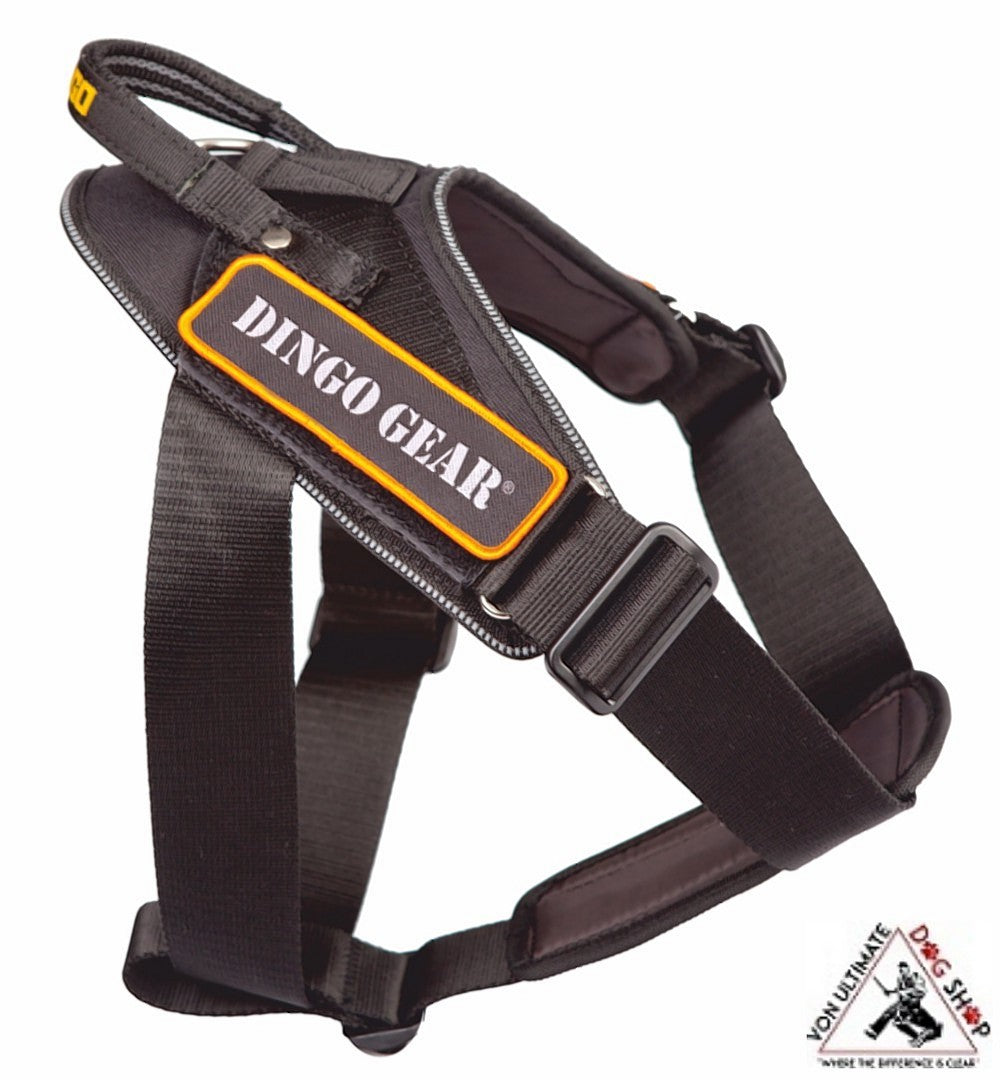
Dingo Gear Multi Purpose Harness
Wide straps and a soft chest plate, with a quick-release plastic buckle. Handcrafted in Poland. Four sizes — Large (75–90 cm girth) fits most adult German Shepherds.
Why I recommend it
Most harnesses on the Australian market are built to stop pulling and end up teaching it. This one is built for working dogs, which means it's designed to let a dog move freely and comfortably while you retain control — tracking, long-line work, drive work, car restraint, or just a dog who needs a break from neck pressure.
The wide straps and padded chest plate are the difference on a strong dog: pressure is spread rather than cutting in, so a Shepherd can lean into it for an hour of tracking without discomfort.
Used in: tracking, long-line and drive work, board and train.
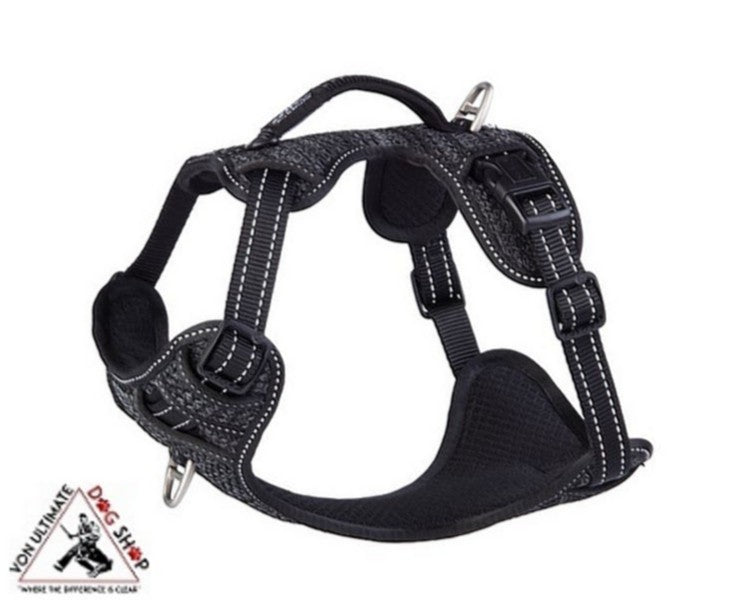
Rogz Extra Large Lumberjack Explore Harness
Nylon webbing with breathable diamond mesh lining and a padded chest plate. Two-point steering — attach the lead at the top for everyday walking or at the chest for extra control. Neoprene support handle, dual buckles with adjustable tri-glides, reflective stitching. Fits 66–95 cm girth. Handmade in South Africa.
Why I recommend it
This is the harness for the adolescent stage — the growing dog who's outgrown puppy gear but isn't at full adult size yet, and who is currently stronger than their brain is developed. The two-point steering is the reason I like it here: front-clip attachment gives you a genuine mechanical advantage during the months where a young Shepherd is testing what happens when they pull.
The support handle earns its place too. Helping an adolescent into a car, over an obstacle, or steadying a nervous dog at the vet is a lot easier with a handle over the shoulders.
Note the girth range — 66–95 cm is adolescent-to-adult sizing, not a young puppy. For a small puppy, start with the lead and collar set above.
Used in: adolescent handling, everyday walking, confidence work with nervous dogs.
Play, engagement and reward
Everything I teach runs on engagement. These are the tools that build it.

Dingo Gear Rubber Nylon Super Grip Lead
A 2 × 150 cm lead with handle, in rubberised nylon. Handmade in Poland.
Why I recommend it
Used in: every 1-on-1 session I run.

Knut Fuchs Protection / Obedience Lead
20 mm wide, 2.1 m long, with a brass clip and three leather stoppers. Cross-ribbed webbing for grip, reinforced against abrasion, water resistant.
Why I recommend it
Used in: advanced obedience, heeling, position work, and board and train.

Knut Fuchs Nylcott Tug
A compact 4 × 8 cm tug designed to sit discreetly under the handler's arm. Colours vary.
Why I recommend it
Used in: heeling, focus work, competition-style obedience.
Distance work, tracking and drive building
Once the foundations are solid, this is the gear that lets you work at distance and build real intensity safely.

Dingo Gear 10 m Gripper Tracking Lead
A 10 m long line in rubberised tape without a handle, so it won't snag. The rubberised surface doesn't slip in the hand. Handmade in Poland.
Used in: recall training, tracking, distance control, and controlled exposure work with reactive dogs.

HST Obedience and Protection Flexi Pole
A two-piece portable pole with a unique spring-action system and bronze clips rather than chrome or brass. Many components rated to 500 kg. Hand-crafted in the Czech Republic.
Used in: advanced drive building, sport foundations, board and train.

Knut Fuchs Bungee Cord
An elastic cord with reinforced outer webbing, designed to attach to bite pads or sleeves.
Used in: engagement work, drive building, reward mechanics.
What I'd buy first
If you're not buying everything at once, here's the order that makes sense.
New puppy (8–16 weeks)
- Puppy lead and collar set
- Ring clicker
- Bungee wool tug
- Flirt pole
Everything at this age is about play, engagement and comfortable handling. That's the whole job.
Adolescent or newly adopted adult (6 months+)
- Herm Sprenger long link in the right length
- Rubber nylon super grip lead
- Lambswool tug
- 10 m gripper tracking lead
Clear communication, a lead you can actually hold, and an honest recall.
Serious about training
- Knut Fuchs obedience lead
- Multi purpose harness
- Cobra collar
- Bungee cord
Precision handling, safe distance work, and reward mechanics that build real drive.
Frequently asked questions
Common questions from German Shepherd owners about training gear.
Do I have to buy all of this?
No. Start with what's relevant to your dog's age, size and where you're at in training. A new puppy needs a puppy lead, a tug and maybe a flirt pole — that's it. An adult dog working on obedience needs one good collar and a lead you can actually hold. Buy what you need now, add pieces as your training progresses.
Why not just buy cheaper gear from a pet shop?
Pet shop gear is generally built for looks, not function. Flat buckle collars roll and pinch unevenly, cheap chain collars have rough edges and weak welds, and most leads are too short, too stiff or too slippery to handle properly under pressure. The gear I recommend is built to last, sized correctly for German Shepherds, and designed to actually work in training. You'll spend less in the long run because you won't be replacing it.
Which collar size do I need for my German Shepherd?
For most adolescent German Shepherds and lighter-framed adult females, the 54 cm Herm Sprenger is the right fit. Most adult German Shepherds of average build go to the 59 cm. Large-framed or heavy-coated males often need the 63 cm. If you're unsure, measure the widest part of your dog's neck and add 5–8 cm. I can also help you size correctly during a session.
Is a harness better than a collar for a German Shepherd?
For most training purposes, no. A harness distributes pressure across the chest and removes the communication channel you need for precise obedience work. I use the multi-purpose harness for specific applications — distance work, tracking, and sport — not as a substitute for a slip or training collar. If someone has recommended a harness because your dog pulls, a harness won't fix pulling. It just makes it more comfortable for the dog to keep pulling.
Do you sell this equipment or earn commission?
No. I don't sell equipment and I don't earn anything from Von Ultimate or any other supplier. I recommend what I actually use because it works. That's the whole reason the list exists.
Can you help me fit it?
Yes. Fitting a slip collar correctly — high on the neck, positioned behind the ears, with the right amount of slack — makes a significant difference to how it communicates. If you buy a collar and aren't sure how to fit it, bring it to your first session and I'll show you.
Have a question that isn't answered here?
Get in TouchReady to put it to work
Equipment doesn't train a dog. It just removes the friction so you can.
If you'd like help choosing what your German Shepherd actually needs — and, more to the point, learning how to use it — book a session with me in Melbourne's south-west.